Your stylist can tell you what looks good on you in about ten seconds. The trick is learning to see it yourself, so you walk into your next appointment already knowing what to ask for.
Face shape is the single biggest factor in whether a haircut works. The same bob that makes one person’s jawline pop can make another person’s face look boxier. Once you know your shape, choosing a flattering cut stops being guesswork.
How to Find Your Face Shape in Two Minutes

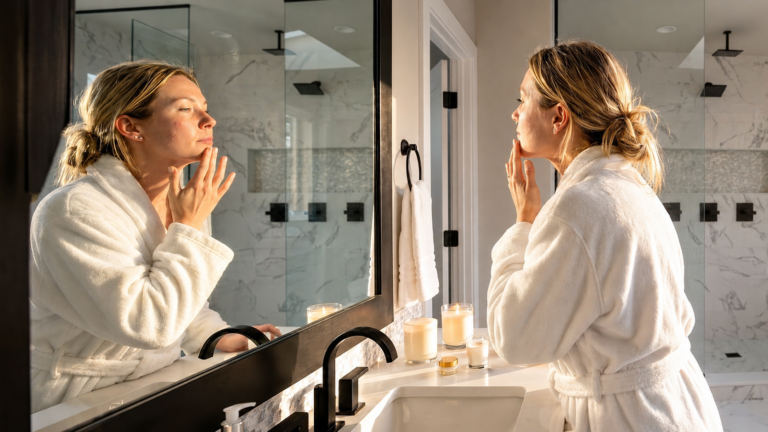
Pull your hair back and stand in front of a mirror with good lighting. Look at three measurements: the width of your forehead, the width of your cheekbones, and the width of your jawline. For a deeper look at how face shape is determined, compare your face length to your face width and note whether your jawline is soft or angular.
If all three widths are close to equal and your jawline is soft, you likely have a round face. If your jawline is sharp and roughly the same width as your forehead, you’re probably square.
A face longer than it is wide, with a longer, straighter silhouette, is oblong. A wide forehead that narrows to a pointed chin is heart-shaped. And if your face is noticeably longer than it is wide with a gently rounded jaw, that’s oval, the shape stylists consider the most versatile.
None of this is an exact science. Plenty of people sit right at the border between two shapes, and that’s fine. Use the guide below as a starting point, then let your stylist confirm it in person.
Oval Face Shape
- Best bets: long layers, a blunt bob at the jawline, side-swept bangs
- What to avoid: styles that add excessive width at the cheekbone, since they can throw off the natural balance
Oval faces have balanced proportions, so almost any cut works. Long layers, blunt bobs, curtain bangs, and pixie cuts can all suit this shape well.
The one thing to watch is covering up the balance that makes oval faces so easy to style. Heavy, face-hugging bangs can flatten the natural proportion. If you have an oval face and want to experiment, this is the shape that gives you the most room to try something bold.
Round Face Shape
- Best bets: long layered cuts, side-swept bangs, height at the crown
- What to avoid: blunt bobs that hit at the widest part of the cheek, and full center-parted bangs, both of which emphasize width
Round faces benefit from height and angles. The goal is to create the illusion of length, not add more width.
Layered cuts with volume at the crown work well, as do styles with a side part instead of a center part. Long layers that start below the chin also help elongate the face.
Square Face Shape
- Best bets: soft layers, side-swept bangs, waves that fall near the jaw
- What to avoid: blunt, geometric cuts that mirror the jawline’s sharp angles
Square faces have a strong, angular jawline and a forehead close to the same width. Soft, wispy layers around the face soften those angles without hiding the bone structure that makes this shape striking.
Side-swept bangs work better than blunt, straight-across bangs, which tend to echo the jaw’s sharp lines. Waves and curls also help by breaking up the strong angles.
Heart Face Shape
- Best bets: chin-length lobs, side-swept or curtain bangs, layers that build volume near the jaw
- What to avoid: styles with a lot of volume at the crown, which can make the forehead look even wider
A heart-shaped face is widest at the forehead and temples, narrowing to a smaller chin. The styling goal is to balance that width up top with a bit more volume near the jaw.
Chin-length bobs and side-swept bangs both work well here. Bangs in particular help minimize a wider forehead, and longer layers that add fullness near the jawline round out the narrower chin.
Oblong Face Shape
- Best bets: full bangs, shoulder-length waves, layers with side volume
- What to avoid: long, straight, one-length styles with no bangs or fullness
Oblong faces are longer than they are wide, often with a strong jaw similar to square faces. The priority here is adding width, not length.
Bangs are one of the most effective tools for an oblong face, since they visually shorten the face. Waves, curls, and layers that add fullness at the sides also help. Very long, straight styles tend to emphasize the length even more.
Diamond Face Shape
- Best bets: chin-length bobs, side-swept bangs, soft layers that add fullness near the jaw
- What to avoid: styles that add a lot of volume at the cheekbones
Diamond faces are widest at the cheekbones, with a narrower forehead and chin. The styling goal is to soften that width through the middle of the face while adding a bit more fullness near the forehead and jaw.
Chin-length bobs and side-swept bangs work well here. Soft layers can also help by adding fullness where the face is narrower, while waves and curls that fall near the jawline create a softer silhouette.
Bringing This Into Your Appointment

Knowing your face shape is only half the equation. Hair texture, thickness, growth pattern, and how much daily styling you’re willing to do all shape the final recommendation too. A stylist who has spent time with your hair type can adjust any of the guidance above to fit how your hair actually behaves.
At A Moment’s Peace, our stylists start every new cut with a consultation, looking at face shape alongside your hair’s natural texture and your day-to-day routine. We’ve also rounded up styles that tend to be the most universally slimming and flattering if you want a head start before your appointment. That combination is what turns a generic flattering cut into one that actually works for you every morning.
Frequently Asked Questions
Can my face shape change over time?
The underlying bone structure stays the same, but weight changes, aging, and even how you’re currently styling your hair can make a shape look different than it is. A stylist consultation is the most reliable way to confirm your shape.
What if I’m between two face shapes?
It’s common to sit at the border between two shapes, especially oval and oblong or round and square. When that happens, bring both options to your consultation and let your stylist help you choose based on your hair texture and lifestyle.
Does face shape matter as much for short hair as long hair?
Yes, and often more. Shorter cuts have less length to soften or balance proportions, so getting the shape right matters even more with a pixie or bob than with longer styles that can be adjusted with parting and volume.
Ready to find the cut that actually works for your face shape? Book a hair consultation with one of our stylists at A Moment’s Peace.